Monday, 19 October 2009
Season of fruits and mellow mistfulness
I surprised myself this morning, strolling into town (to the dentist as it happens). It was wet and overcast and the leaves were really beginning to turn and fall, and I thought to myself what a relief it was that the summer was over. That's what surprised me. Normally I love the warm weather and tend to get a little depressed when it's over, but no, today I was positively buoyant.
The summer has been 'disappointing' they say, but then they say that every year. Normally I'd disagree but this year... What's it been? It's not been the rain - we've had something of a drought. Things have been looking quite sorry for themselves. Maybe it's been the sun. It's been dry, but it hasn't been bright, which is an unsatisfying state of affairs. This carried on until early October, by which time I was heartily sick of it. The cold and wet came as a welcome reprieve.
Actually I've known for a while I have a problem with August - memories of wet camping holidays as a child I expect. August is a con. It's not summer. August is the overture to autumn (as February is the overture to spring). You can feel it in the air. May and June are summer. I noted this year that things started to go off soon after the solstice. You might have noticed if you've been keeping up with the Emma's Garden photoset on Flickr that there's a lot fewer pictures from July to September than for other times. There's just nothing photogenic going on (unless you're into macro when you can look at the flowers in isolation and ignore the total ho-humness of everything around them.)
So now I look around at the garden and am once again filled with energy. Finally I can do something. As you'll know by now I'm not a fan of the well ordered neat-and-tidy sort of garden and I don't cut things down until I have to, but there's been a few things I've been looking at since July and inwardly groaning. It's my first full year here and I'm still very much learning how to grow things on this soil (clay, not much sun - the total opposite to gardening on the chalk near Lewes.) Things really have taken off here, especially in what I call the sunny border (it's all relative.) The Diascia personata especially has formed a huge engulfing mass, obscuring several less vigorous plants that I hope will still be there when I come to cut the Diascia back (or remove most of it actually.) Salvia uliginosa, which I thought would stand up straight behind and amongst it has flopped over on top of it, and the Helianthus atrorubens, also included for the tall dark wiry stems I imagined would stand tall behind that, has also fallen forward over everything. The problem is partly a red maple (bought as a standard tree some years back - it has never thrived), the fence behind and the path in front. Plants do not just passively fall over, they 'perceive' the path as an open space to grow into, and the tree and fence as shade and competition to grow away from. Hence they end up horizontal, getting trodden on. The mass of undergrowth was satisfying for a time - the Buddleia lindleyana held it's own well, the Eryngium giganteum elbowed its way up through the tangle, Gladiolus tristis shot up to 6ft high of so to get it's peculiar flowers into the light, like Diplodocus heads peering out of a thicket. But Rudbeckia maxima is under there somewhere, as are a couple of Dierama and two Decaisnea. I hope they'll recover. Kniphofia caulescens has definitely rotted off.
So anyway, perhaps you'll understand how, despite the fact that the Diascia and the Salvia are still blooming away, I'll be glad to get in there with the secateurs. The Diascia anyway I can honestly say I am thoroughly bored with. People always want to know about plants that just go on and on flowering all summer long, and if that's what you want I can heartily recommend it. You can have some of mine in fact (they're extremely easy from cuttings and totally hardy) but I'm sick of it. I like my season-long interest to come from the turn-over - things coming and going, changing places.
So that's one job. Whatever Diascia personata I keep will be further back, mixed in amongst everything else.
Then there's the huge Miscanthus in the middle of the border too. I can't wait for that to go over so I can have it out and do something better with that space. The maple will have to go too (it's had its chance) and the Lavatera Lilac Lady beside it. It's a good form - smaller that the commoner varieties and a nicer colour but not what I want now really. That'll leave a huge gap. I can't wait. Everything'll transpire a huge sigh of relief.
As for the rest of the garden - there's similar stories elsewhere. Mostly I'll leave the stems and old seed heads as long as I can - probably until January. I'll leave a stubble to discourage the dog from wandering about snapping off the new growths in spring. I'll make hazel 'bird-cages' for the Salvia and the Helianthus to grow through to support them through next summer. I've taken down the Bronze Fennel because I don't want too many of her offspring - lovely as she is.
People assume fallen leaves smother plants but except for small evergreens (lawns for example) that's rarely so, and the worms take them away and feed the soil in the process. People also like to cut things down as soon as possible after flowering - to get a second flush of flowers or make the plant put it's resources into the roots instead of the seed heads. I'm not sure either of these things make that much difference to most plants. I think it's more about neat and tidiness and I prefer the untidy textures and colours of autumn.
Which brings me back to my original point. When the dusty, listless scruffiness of August gave way to death's rich tapestry a couple of weeks back it was a release. Last 'summer' seemed interminable, but now, here we are, ready to move on again...
Monday, 28 September 2009
Persicaria virginiana and filiformis
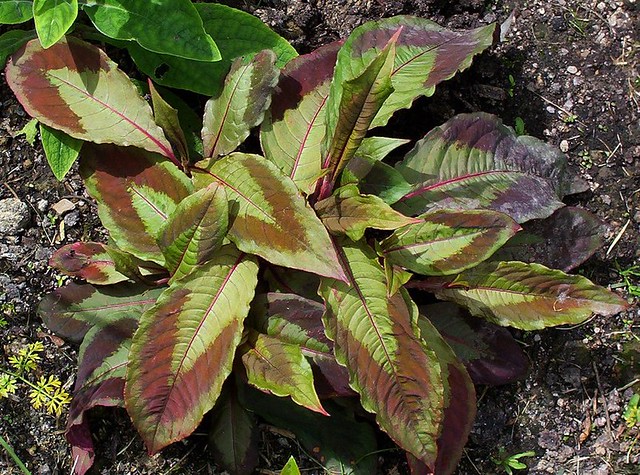
Persicaria virginiana Compton's form
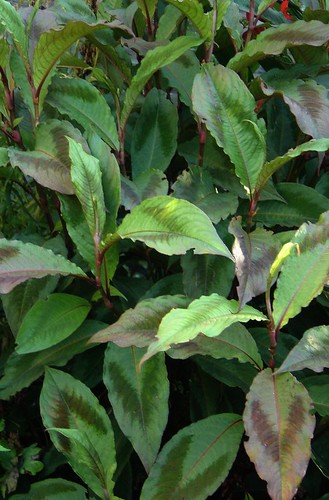
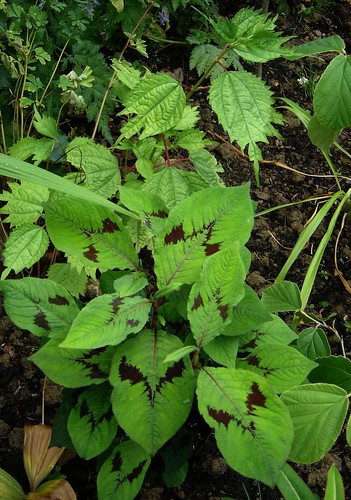
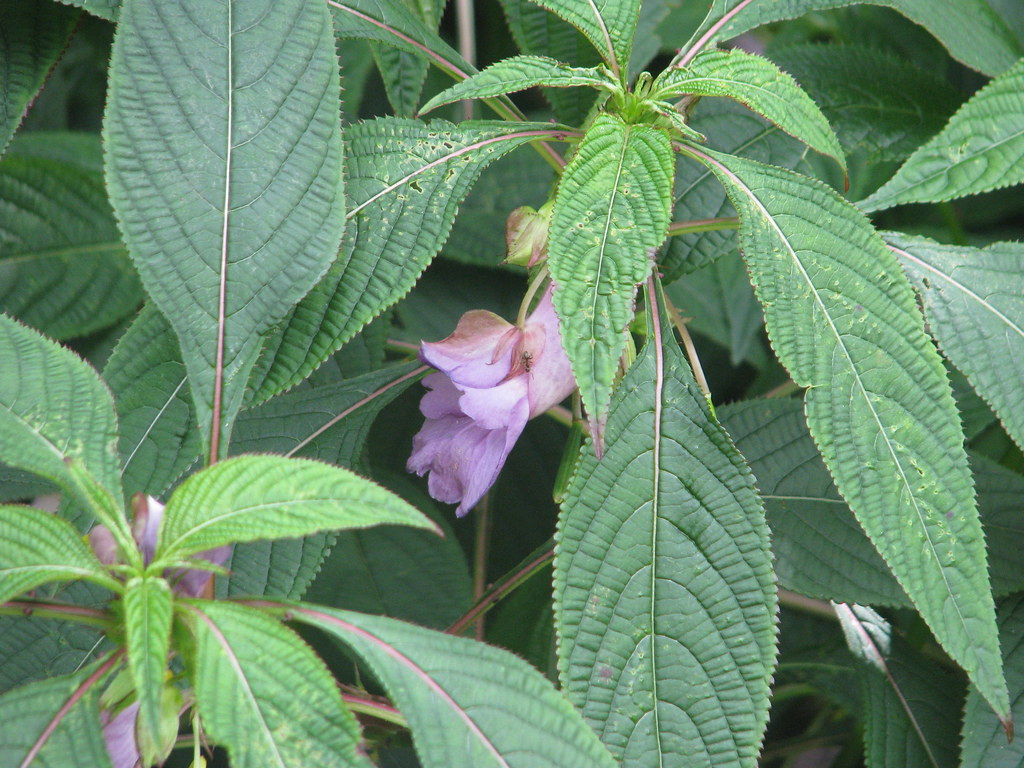
This American species is not that often offered, possibly because the flowers are quite small bright red filaments and appear in Autumn. A magnificent foliage plant though - as good as many of the tropical Calatheas and Marantas (prayer plants). The leaf surface has a real lustre - richly coloured and with an odd black chevron - I know not why.

A good solid perennial for any soil in sun or semi shade. Height up to 4ft and not at all invasive.
£8
This American species is not that often offered, possibly because the flowers are quite small bright red filaments and appear in Autumn. A magnificent foliage plant though - as good as many of the tropical Calatheas and Marantas (prayer plants). The leaf surface has a real lustre - richly coloured and with an odd black chevron - I know not why.

A good solid perennial for any soil in sun or semi shade. Height up to 4ft and not at all invasive.
£8

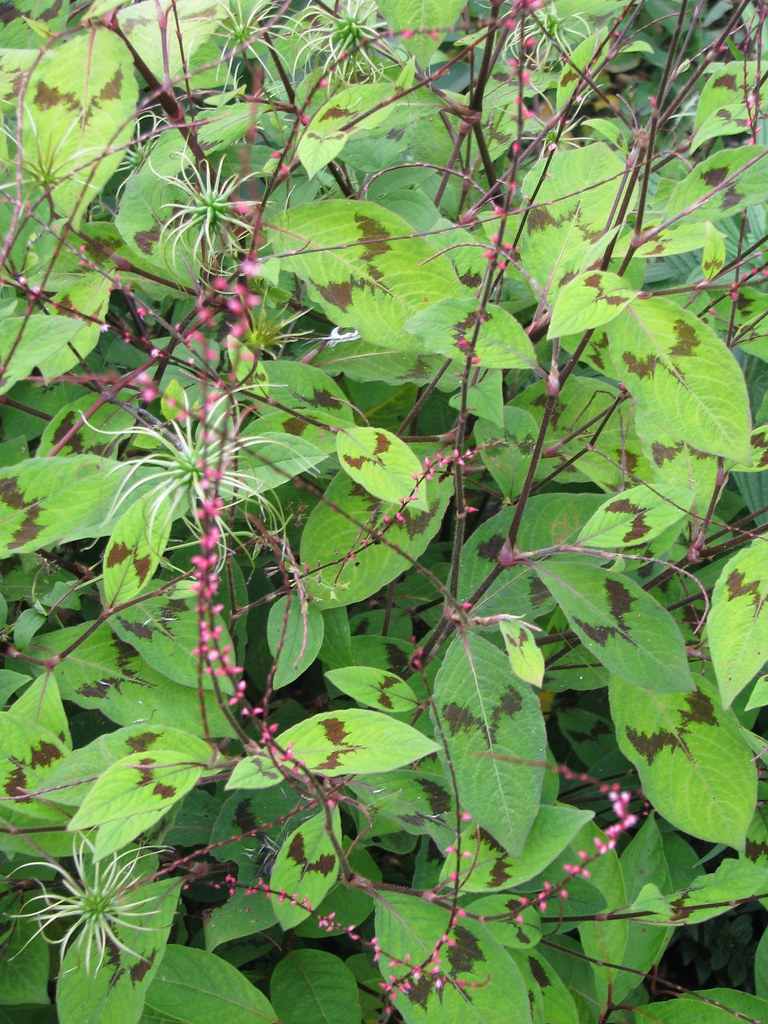
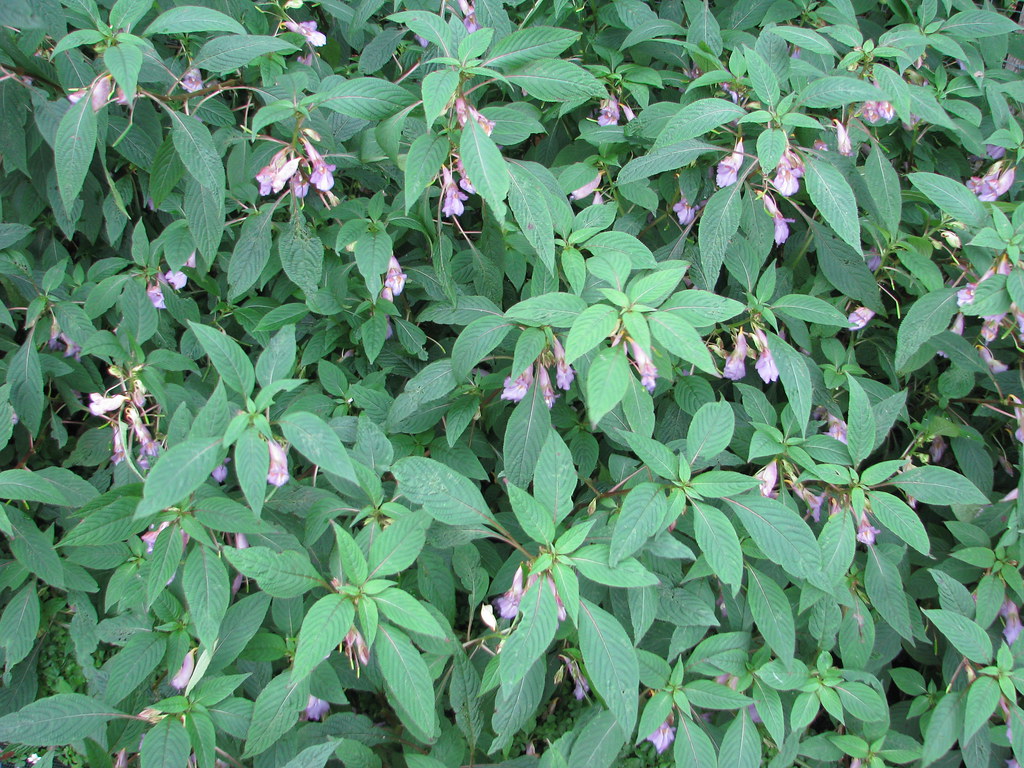
The red filamentous inflorescences are produced earlier, in late summer/early autumn. It does seed about a little but in a good way. Very adaptable but best on moist soils
£8
Labels:
brighton,
Compton's form,
filiformis,
Guizhou,
nursery,
persicaria,
plants,
polygonum,
virginiana
Wednesday, 26 August 2009
Saturday, 15 August 2009
Salix gracilistyla melanostachys
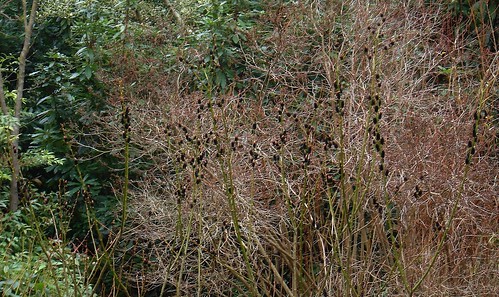
A very wacky willow for you, this time grown for it's bituminous black catkins in early spring which sprout pale yellow anthers and have red highlights.
It's hard to get a good shot of this from a distance with any 'interference' in the background, but the black catkins, (see photo below) are striking. Potentially a large shrub but responds well to quite hard pruning immediately after flowering.

Specimen size plants - £30 - collection only
It's hard to get a good shot of this from a distance with any 'interference' in the background, but the black catkins, (see photo below) are striking. Potentially a large shrub but responds well to quite hard pruning immediately after flowering.

Specimen size plants - £30 - collection only
Labels:
brighton,
gracilistyla,
melanostachys,
nursery,
plants,
salix
Saturday, 8 August 2009
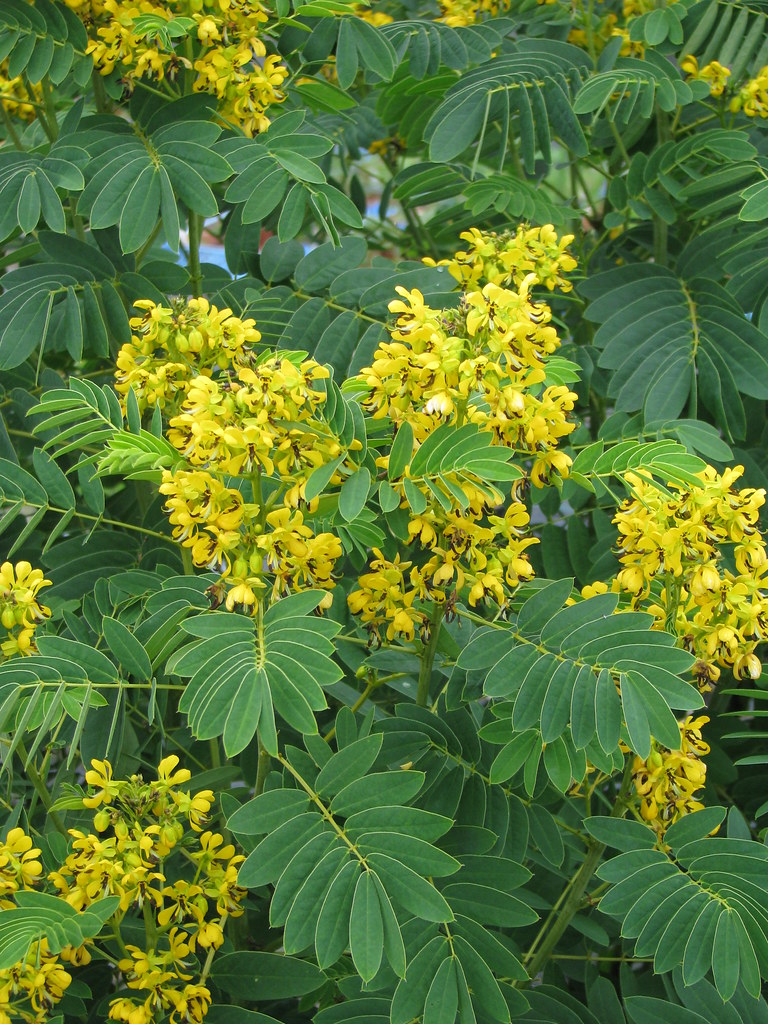
Senna hebecarpa

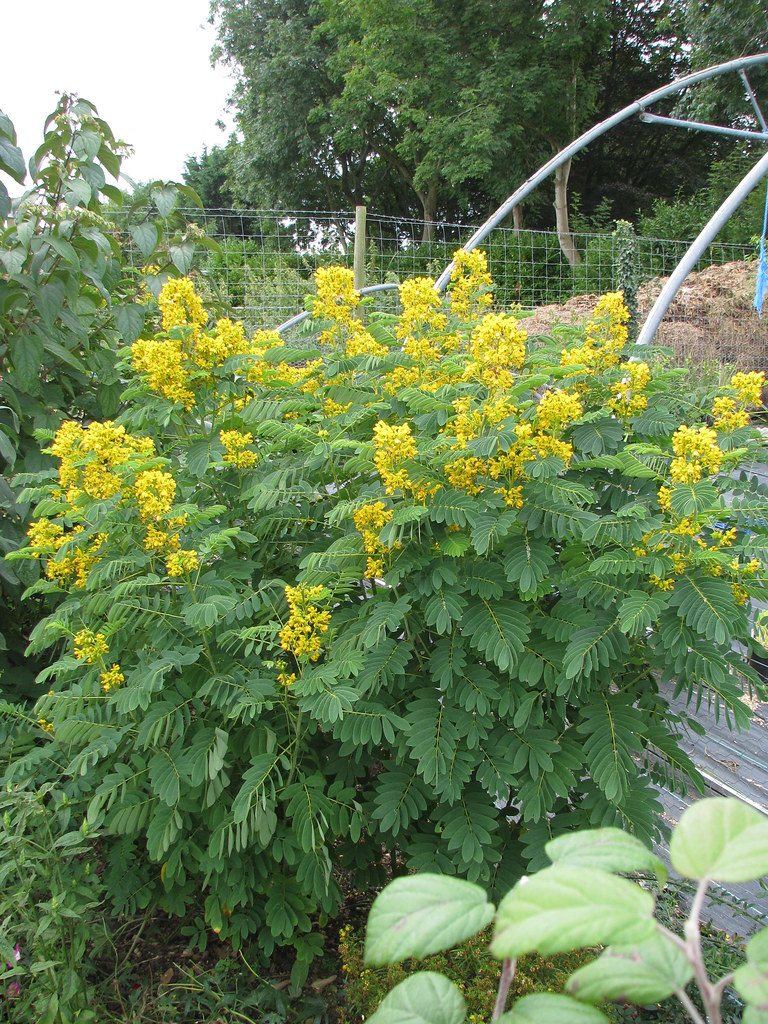
I'm not sure why the North American Sennas are not better known in the UK. I know two of them reasonably well - hebecarpa and marilandica (both sometimes included in Cassia.) The former seems to be the better of the two. They're big exotic looking plants but completely hardy given their distribution as far north as the Great Lakes.
The foliage is lush and the flowers give a good show in the latter part of the summer.

Ideal for prairie type plantings with other native Americans (so to speak) they grow well in moist rich soils in full sun but should tolerate some shade and drought.
3L pots ~ £10
Saturday, 1 August 2009
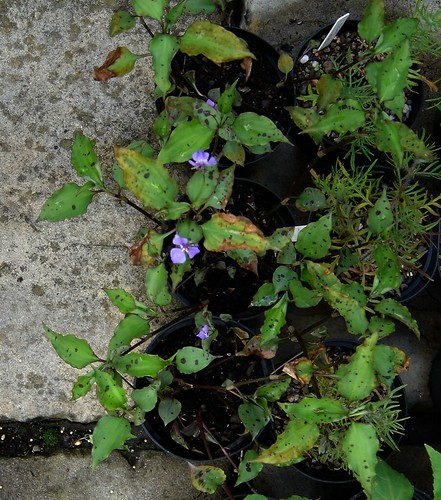
Tinantia pringlei
A hardy Mexican relative of the popular houseplant Tradescantias. It dies back completely in winter but comes back strongly from the roots in spring forming a dense ground-cover. The foliage is black spotted (not diseased) and there is a succession of the little three-petalled mauve flowers through the summer.
Completely hardy through the last few winters here in Sussex, and in fact inclined to turn up in unexpected places around the garden.
Thank you so much.
Completely hardy through the last few winters here in Sussex, and in fact inclined to turn up in unexpected places around the garden.
clumps lifted from the ground - £5
Please please please, may I humbly request that you check with me that the plants you require are in stock before you order? Otherwise we'll have to arrange refunds.
Thank you so much.
Sunday, 26 July 2009
Mediterranean and Sub-tropical
A couple of years back I was very excited to read the catalogue of a nursery called Koba Koba, based somewhere down in Devon. (I just checked - they've closed apparently.) I was excited because they were offering a substantial list of 'hardy' gingers and other 'hardy' subtropical plants such as Musa (bananas) and Amorphophallus (those extraordinary giant Arums that stink of rotting meat) and at the time I was very drawn to the whole 'hardy exotics'/'architectural plants' thing. The plants they offered had always interested me but like most gardeners in the UK, I'd thought of them only as specimens for tropical greenhouses and conservatories. A book on the subject (Hardy Gingers by T.M.E.Branney, Timber Press) came out and I duly obtained my copy.
I was aware that some genera in the family (Hedychium, Roscoea, Cautleya) included some good hardy species but was astounded by the variety of what I had previously considered truly tropical groups (Zingiber, Alpinia, Costus, Kaempferia and Curcuma for example) that could tolerate apparently much lower temperatures than we have experienced in this part of the world for many years (-12C for Alpinia zerumbet, -15C for Costus speciosus for example). I couldn't wait to try some.
What was not apparent until I got over my euphoria was that these temperatures are only tolerated if the roots are kept completely dry in the winter.
I'll let that sink in for a moment...
That's completely dry. In the winter... In the UK...
Clearly someone has a funny idea what 'hardy' means but I hesitate to say that they were deliberately misleading us in order to sell plants (or books) but I have a more interesting point to make here because this was the first time in my 20 years gardening career that I had genuinely understood the importance of climate in gardening beyond merely taking into account a plant's tolerance of cold.
What we perhaps forget, living in the UK where it seems to rain more or less equally all year round, is that in many parts of the world, and not just the tropics, there is a definite wet and dry season. We in Northern Europe actually live in a winter wet part of the world. It doesn't seem like it much of the time because Britain has a maritime climate (remember your high school geography) which is never dry for long, but travelling due east, across Europe and into Central Asia it becomes increasingly obvious how much of the year's rain (or snow) falls in the Autumn-Spring period, and, saving a few thunder storms, how little falls in the summer. The difference is striking even between Devon and Essex if you look at the statistics. The Mediterranean area is, as I understand it, just the southern limit of this temperate winter rainfall zone, where summer heat is high enough to cause enough evaporation to create a semi-desert environment. The amount of rainfall annually is not that different to northern Europe.
Similar environments (known as 'Mediterranean' for short) can be found wherever similar situations occur all over the world, where the temperate winter rainfall zone slips equatorwards along the west coast - in California, parts of northern Chile, the Western Cape of South Africa, and the southern corner of West Australia. These regions are unusually harsh environments - the hot and dry seasons coinciding means that most plants are active in the winter and dormant during the summer (spring bulbs for example.)
A lot of plants from these areas will not tolerate freezing (although a surprising number will - at least to -5C) but generally, 'Mediterranean' plants are relatively easy to grow in the UK because we have something like the same climate, with relatively dry summers. As long as the plants are grown in the sunniest spot available and the soil drains very freely they can be extraordinarily hardy. They're especially useful in situations that become completely parched in summer - on chalk and sand soils for example, and up against south and east-facing walls. They also tolerate the drying effects of hedge and tree roots as long as they will also tolerate some shade.
Not so for plants from summer rainfall areas. Mediterranean climate areas cover a very small part of the world but summer rainfall is normal over almost all of the rest of world's land surface. We are used to hearing about the hurricane season in the USA and the Monsoon in India or Thailand, but it's much the same throughout southern and eastern Asia, eastern and northern Australia, much of South America and almost all of Africa. The only exceptions are the equatorial tropics where the rain falls all year round and where the rainforest dominates (or used to) and the zones between the winter wet Mediterranean areas and the summer wet subtropical areas where almost no rain falls at all. This is where the major deserts form.
Much of this area is far too tropical to provide plants for our British gardens but where the summer rainfall zone slips polewards along the east coast it takes in parts of temperate Eastern Asia, south eastern Australia and New Zealand, a small part of south eastern Africa, parts of South America and a large slice of southern USA and Mexico. In these areas the winter temperatures can be similar to those we get here, but without the wet.
So were the 'hardy gingers' a bit of a scam? Well, maybe. But summer rainfall plants aren't as useless as you might think. Many of them come from remarkably cold parts of the world. The deserts of North America extend all the way into Canada and provide us with some incredibly frost tolerant cacti and Agave. Even plants from as far south as Arizona and New Mexico, Alabama and Georgia may suffer much harder winters than we do. Plants from Patagonia and parts of central China are in a similar position. The Eastern Australians and Africans are generally less frost tolerant but especially if they come from upland areas, they can be amazingly adaptable too. The Agapanthus, Kniphofia, Phygelius, Galtonia and Crocosmia we grow come from the highlands of east Africa. The area from southern Brazil to northern Argentina gives us many good garden Salvias (uliginosa, guaranitica, involucrata), Passiflora caerulea, Abutilon megapotamicum and Gunnera manicata. Australia is less generous but this may have more to do with the quality of the soil than the climate. I have kept Banksias, Correas, Lomatias and Grevilleas from New South Wales outdoors all year round in pots for the last fifteen years, and lost none except a Correa I planted out last year. The trick is to keep them as dry at the root as possible - it is commonly believed that any plant of doubtful hardiness will be better off in the ground as the soil will insulate the roots but this is not necessarily the case. Potted plants dry out quickly, especially if somewhat root bound. Thus it helps if your 'subtropical' plants are drought tolerant desert dwellers.
The problem then with the 'hardy gingers' mentioned above is that, during the growing season they are not at all drought tolerant. Alpinia, Costus and Curcuma are woodlanders and need moist, rich, even wet soil during the summer, as do the Amorphophallus. I can't think of any way of arranging the wet summer/dry winter regime these plants need in the open garden in the UK unless it's by lifting them in the winter and storing them like Dahlias (which are of course the classic winter rainfall plant). Not all plants put up with this sort of disturbance.
One final point I must add. Along with the wet summer many of these plants require, is a need for heat and light during the growing season that is often hard to provide in the UK. Plants from the southern states of the USA for example may experience freezes like nothing we see here, but the summers are long and hot and, in between storms, bright and sunny. An extraordinary plant like Hibiscus coccineus is totally frost hardy but may not come into growth early enough to flower before the autumn frosts cut it back down again. Some Hedychium have similar problems. If we want to grow these fabulous plants we may have to borrow some tricks from the vegetable growers - using black plastic to heat the soil up early for example. They'll need siting in the hottest possible situation and yet in a spot that is moist and fertile. A west facing wall may help.
On the other hand, in the deserts of Australia and Arizona for example, a bitterly cold winter night is typically followed by a bright dry winter day. A south or east facing wall or similar is our best hope for these plants.
Finally, woodlanders from the monsoon zones of southern and eastern Asia (Tricyrtis, Arisaema, Calanthe, Anemonopsis, Deinanthe, Asarum etc etc) do not tolerate the dry summers we have in eastern England at all well, exacerbated as it is by trees, sucking up every last drop of moisture. They will enjoy a dank north-facing exposure and a woodsy soil without nearby trees rooting into it.
Ok, that's more than enough for now. You will have noticed that I don't feel the need to write my blog in little twitterish 'sound-bites' as seems fashionable, and actually, I really like the old essay form, or a good solid article in a 'proper' journal. I hope you have the stamina and find it worthwhile.
I was aware that some genera in the family (Hedychium, Roscoea, Cautleya) included some good hardy species but was astounded by the variety of what I had previously considered truly tropical groups (Zingiber, Alpinia, Costus, Kaempferia and Curcuma for example) that could tolerate apparently much lower temperatures than we have experienced in this part of the world for many years (-12C for Alpinia zerumbet, -15C for Costus speciosus for example). I couldn't wait to try some.
What was not apparent until I got over my euphoria was that these temperatures are only tolerated if the roots are kept completely dry in the winter.
I'll let that sink in for a moment...
That's completely dry. In the winter... In the UK...
Clearly someone has a funny idea what 'hardy' means but I hesitate to say that they were deliberately misleading us in order to sell plants (or books) but I have a more interesting point to make here because this was the first time in my 20 years gardening career that I had genuinely understood the importance of climate in gardening beyond merely taking into account a plant's tolerance of cold.
What we perhaps forget, living in the UK where it seems to rain more or less equally all year round, is that in many parts of the world, and not just the tropics, there is a definite wet and dry season. We in Northern Europe actually live in a winter wet part of the world. It doesn't seem like it much of the time because Britain has a maritime climate (remember your high school geography) which is never dry for long, but travelling due east, across Europe and into Central Asia it becomes increasingly obvious how much of the year's rain (or snow) falls in the Autumn-Spring period, and, saving a few thunder storms, how little falls in the summer. The difference is striking even between Devon and Essex if you look at the statistics. The Mediterranean area is, as I understand it, just the southern limit of this temperate winter rainfall zone, where summer heat is high enough to cause enough evaporation to create a semi-desert environment. The amount of rainfall annually is not that different to northern Europe.
Similar environments (known as 'Mediterranean' for short) can be found wherever similar situations occur all over the world, where the temperate winter rainfall zone slips equatorwards along the west coast - in California, parts of northern Chile, the Western Cape of South Africa, and the southern corner of West Australia. These regions are unusually harsh environments - the hot and dry seasons coinciding means that most plants are active in the winter and dormant during the summer (spring bulbs for example.)
A lot of plants from these areas will not tolerate freezing (although a surprising number will - at least to -5C) but generally, 'Mediterranean' plants are relatively easy to grow in the UK because we have something like the same climate, with relatively dry summers. As long as the plants are grown in the sunniest spot available and the soil drains very freely they can be extraordinarily hardy. They're especially useful in situations that become completely parched in summer - on chalk and sand soils for example, and up against south and east-facing walls. They also tolerate the drying effects of hedge and tree roots as long as they will also tolerate some shade.
Not so for plants from summer rainfall areas. Mediterranean climate areas cover a very small part of the world but summer rainfall is normal over almost all of the rest of world's land surface. We are used to hearing about the hurricane season in the USA and the Monsoon in India or Thailand, but it's much the same throughout southern and eastern Asia, eastern and northern Australia, much of South America and almost all of Africa. The only exceptions are the equatorial tropics where the rain falls all year round and where the rainforest dominates (or used to) and the zones between the winter wet Mediterranean areas and the summer wet subtropical areas where almost no rain falls at all. This is where the major deserts form.
Much of this area is far too tropical to provide plants for our British gardens but where the summer rainfall zone slips polewards along the east coast it takes in parts of temperate Eastern Asia, south eastern Australia and New Zealand, a small part of south eastern Africa, parts of South America and a large slice of southern USA and Mexico. In these areas the winter temperatures can be similar to those we get here, but without the wet.
So were the 'hardy gingers' a bit of a scam? Well, maybe. But summer rainfall plants aren't as useless as you might think. Many of them come from remarkably cold parts of the world. The deserts of North America extend all the way into Canada and provide us with some incredibly frost tolerant cacti and Agave. Even plants from as far south as Arizona and New Mexico, Alabama and Georgia may suffer much harder winters than we do. Plants from Patagonia and parts of central China are in a similar position. The Eastern Australians and Africans are generally less frost tolerant but especially if they come from upland areas, they can be amazingly adaptable too. The Agapanthus, Kniphofia, Phygelius, Galtonia and Crocosmia we grow come from the highlands of east Africa. The area from southern Brazil to northern Argentina gives us many good garden Salvias (uliginosa, guaranitica, involucrata), Passiflora caerulea, Abutilon megapotamicum and Gunnera manicata. Australia is less generous but this may have more to do with the quality of the soil than the climate. I have kept Banksias, Correas, Lomatias and Grevilleas from New South Wales outdoors all year round in pots for the last fifteen years, and lost none except a Correa I planted out last year. The trick is to keep them as dry at the root as possible - it is commonly believed that any plant of doubtful hardiness will be better off in the ground as the soil will insulate the roots but this is not necessarily the case. Potted plants dry out quickly, especially if somewhat root bound. Thus it helps if your 'subtropical' plants are drought tolerant desert dwellers.
The problem then with the 'hardy gingers' mentioned above is that, during the growing season they are not at all drought tolerant. Alpinia, Costus and Curcuma are woodlanders and need moist, rich, even wet soil during the summer, as do the Amorphophallus. I can't think of any way of arranging the wet summer/dry winter regime these plants need in the open garden in the UK unless it's by lifting them in the winter and storing them like Dahlias (which are of course the classic winter rainfall plant). Not all plants put up with this sort of disturbance.
One final point I must add. Along with the wet summer many of these plants require, is a need for heat and light during the growing season that is often hard to provide in the UK. Plants from the southern states of the USA for example may experience freezes like nothing we see here, but the summers are long and hot and, in between storms, bright and sunny. An extraordinary plant like Hibiscus coccineus is totally frost hardy but may not come into growth early enough to flower before the autumn frosts cut it back down again. Some Hedychium have similar problems. If we want to grow these fabulous plants we may have to borrow some tricks from the vegetable growers - using black plastic to heat the soil up early for example. They'll need siting in the hottest possible situation and yet in a spot that is moist and fertile. A west facing wall may help.
On the other hand, in the deserts of Australia and Arizona for example, a bitterly cold winter night is typically followed by a bright dry winter day. A south or east facing wall or similar is our best hope for these plants.
Finally, woodlanders from the monsoon zones of southern and eastern Asia (Tricyrtis, Arisaema, Calanthe, Anemonopsis, Deinanthe, Asarum etc etc) do not tolerate the dry summers we have in eastern England at all well, exacerbated as it is by trees, sucking up every last drop of moisture. They will enjoy a dank north-facing exposure and a woodsy soil without nearby trees rooting into it.
Ok, that's more than enough for now. You will have noticed that I don't feel the need to write my blog in little twitterish 'sound-bites' as seems fashionable, and actually, I really like the old essay form, or a good solid article in a 'proper' journal. I hope you have the stamina and find it worthwhile.
Subscribe to:
Posts (Atom)